

You've seen the headlines.
AI is transforming industries. Competitors are automating. Investors want to hear your AI strategy.
So you're thinking about implementing AI in your business. But here's the question nobody's asking:Is your business actually ready for it?
Research from RAND Corporation shows over 80% of AI projects fail to reach meaningful production deployment, which is twice the failure rate of IT projects without AI components.
The technology isn't the problem. Organisational readiness is.
This guide walks you through everything you need to know about AI readiness assessments: what they are, why they matter, what frameworks exist, and where to get one.
What Is an AI Readiness Assessment?
An AI readiness assessment is a structured evaluation of your organisation's capability to adopt, integrate, and scale artificial intelligence technologies in a way that delivers measurable value while managing associated risks.
Think of it as a health check for your business before you commit to AI adoption.
The assessment examines multiple dimensions of your organisation, from data infrastructure and technical capabilities to team skills and company culture. The goal isn't just to tell you whether you're ready. It's to identify strengths, uncover gaps, highlight risks, and provide a clear roadmap for moving forward.
For UK startups and SMEs, this matters enormously. You don't have the budget for failed experiments.
A proper assessment helps you avoid wasting resources on AI projects doomed from the start.
Why AI Readiness Assessment Matters for Businesses and Startups
The statistics are sobering. According to Gartner research, only 48% of AI projects make it into production, and it takes an average of eight months to go from prototype to deployment. At least 30% of generative AI projects will be abandoned after proof of concept by the end of 2025.
The reasons are predictable. Poor data quality. Lack of internal skills. Cultural resistance. Unclear business objectives.
An AI readiness assessment helps you avoid these pitfalls by answering critical questions before you invest. Do you have clean, accessible data? Does your team have the technical knowledge? Is your leadership genuinely committed? Are you compliant with GDPR and the EU AI Act?
For startups, the stakes are even higher. You're operating with limited runway, and every pound spent on a failed AI initiative is a pound not spent on growth. Investors increasingly want to see that you have a realistic AI strategy, not just buzzwords.
Understanding the AI Readiness Assessment Framework
An AI readiness framework provides a structured methodology for evaluating your organisation's preparedness across multiple dimensions. Rather than guessing whether you're ready, frameworks break down "readiness" into measurable components you can assess and improve.
Most established frameworks, including those from Cisco, Microsoft, sensiwise.ai and independent consultancies, organise assessment around six to eight core pillars covering strategy, data, technology infrastructure, governance, talent, and culture.
The framework approach creates visibility into both strengths and weaknesses, produces a prioritised roadmap for building genuine AI readiness, and helps you benchmark progress over time.
Many frameworks include maturity models that categorise organisations into tiers, from initial awareness through to full AI integration. Cisco's AI Readiness Index, for instance, groups companies into Pacesetters, Chasers, Followers, and Laggards based on their capabilities across each pillar.
What Does an AI Readiness Assessment Cover?
Most comprehensive assessments evaluate your organisation across seven key pillars:
AI Vision and Strategy
Does your leadership have a clear vision for AI integration? Are AI goals aligned with broader business objectives? Is there a phased implementation roadmap? This pillar ensures you're not adopting AI for its own sake but connecting it to measurable business outcomes.
Data Foundations and Maturity
AI is only as good as the data that feeds it. This pillar examines your data quality, accessibility, governance, and pipeline infrastructure. If you're sitting on messy, siloed data, AI will amplify those problems rather than solve them.
Technology Infrastructure
Does your current tech stack support AI implementation? This includes cloud capabilities, computing resources, integration capabilities, and security protocols. Organisations with outdated legacy systems often face significant hurdles here.
People and Skills
Do you have the talent to build, deploy, and maintain AI systems? This pillar assesses technical skills across your team and highlights areas where external consultants or upskilling programmes may be required. Research indicates that lack of skills and data literacy ranks among the top obstacles to AI success.
Cultural Readiness
Is your organisation willing to change? AI adoption isn't just a technology shift. It's a cultural one. This pillar examines management support, employee attitudes toward AI, and the organisation's history of embracing or resisting change.
Process Readiness
Are your business processes documented and optimised enough for AI integration? AI works best when layered onto well-understood, efficient workflows. If your processes are chaotic, AI will struggle to deliver value.
Ethics and Governance
With GDPR and the EU AI Act, UK businesses face increasing regulatory scrutiny. This pillar ensures you have appropriate policies for data protection, algorithmic transparency, and ethical AI deployment. The UK Government's AI Regulation Policy Paper provides essential frameworks here.
What to Consider Before Getting an AI Readiness Assessment
Before you engage any provider or start implementing AI, there are critical factors you need to evaluate honestly.
Define Your Business Problem First
AI isn't a solution looking for a problem. Start by identifying specific pain points in your business, whether that's customer response times, manual data entry, or demand forecasting. The clearest AI successes come from organisations that know exactly what problem they're solving.
Audit Your Data Situation
Data is the fuel for AI. Take stock of where your business data lives, how clean it is, and whether you have the legal rights to use it for AI training. Many UK businesses discover their data is scattered across spreadsheets and legacy systems, which is a problem that needs solving before AI can help.
Assess Your Budget Realistically
AI implementation isn't just about software costs. Factor in infrastructure upgrades, staff training, consulting fees, and ongoing maintenance. Understanding the true costs is essential before committing to any AI initiative.
Evaluate Your Team's Readiness
What AI skills exist in-house? What's the general attitude toward AI adoption, excitement or anxiety? Consider whether you'll need to hire specialists or partner with external consultants to fill capability gaps. Resistance from key staff can derail even the best-planned AI projects.
Check Your Compliance Position
Review your data protection practices against ICO guidelines. With the EU AI Act coming into force, UK businesses face new requirements around algorithmic transparency and risk classification.
Start Small, Think Big
The most successful AI adopters don't transform everything at once. Identify one or two high-impact use cases where you can prove value quickly. Early wins build momentum and internal buy-in for larger initiatives.
AI Readiness Assessment Providers
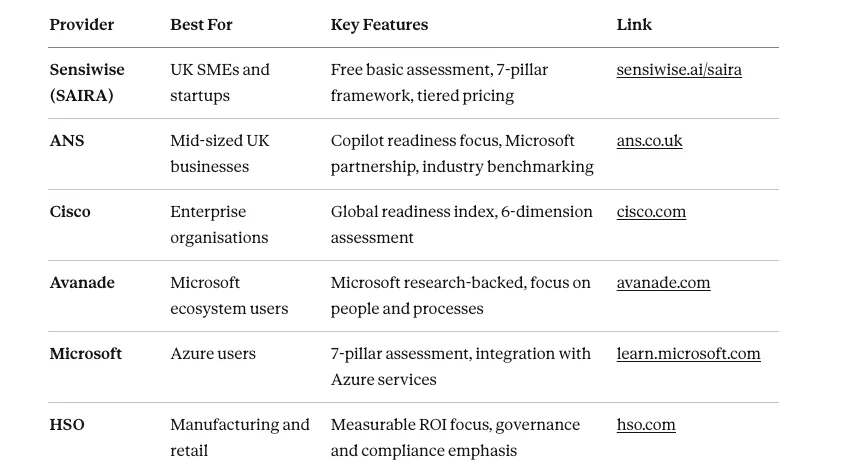
Several organisations offer AI readiness assessments tailored to UK businesses:
Sensiwise (SAIRA): UK SMEs and startupsFree basic assessment, 7-pillar framework, tiered pricing sensiwise.ai/saira
ANS: Mid-sized UK businessesCopilot readiness focus, Microsoft partnership, industry benchmarkingans.co.uk
Cisco: Enterprise organisationsGlobal readiness index, 6-dimension assessment cisco.com
Avanade: Microsoft ecosystem usersMicrosoft research-backed, focus on people and processesavanade.com
Microsoft: Azure users7-pillar assessment, integration with Azure serviceslearn.microsoft.com
HSO: Manufacturing and retailMeasurable ROI focus, governance and compliance emphasishso.com
Benefits of AI Readiness Assessment
Why invest time in an assessment before jumping into AI projects?
Competitive advantage. Understanding your readiness lets you move strategically while competitors waste resources on poorly planned initiatives.
Cost efficiency. Assessments help you target AI investments where they'll actually work. One HSO customer saved £80,000 annually by implementing AI in the right area identified through their assessment.
Risk reduction. With GDPR and the EU AI Act, getting AI governance wrong can be costly. Assessments ensure you're building compliance into your strategy from day one.
Better decision-making. Clean, connected, compliant data is the foundation of useful AI. Assessments identify data issues before they become expensive problems.
Cultural alignment. The assessment process helps transform resistance into buy-in by involving stakeholders early and addressing concerns directly.
Scalability. Start small, prove value, then expand. Assessments help you identify quick wins that build momentum for larger AI transformation.
Key Takeaways
AI readiness isn't about having the most advanced technology. It's about having the right foundations across strategy, data, infrastructure, people, culture, processes, and governance.
The businesses that succeed with AI don't rush in. They assess their readiness, address their gaps, and build a clear roadmap before investing heavily.
For UK startups and SMEs, a free assessment like Sensiwise SAIRA provides an excellent starting point. Larger organisations might benefit from enterprise-focused assessments offered by Cisco, Avanade, or HSO.
The window for AI adoption is closing. Get your assessment done. Understand your gaps. Then move forward with confidence.
Building a tech startup in the UK? Join The Tech Founders community for more guides on scaling your business, navigating funding, and staying ahead of industry trends.