
You have got a great idea. You have done the research. Maybe you have even built a prototype. But when you sit across from an investor, the first thing they are actually evaluating is not your product.
It is you.
Specifically, they are asking themselves one question: is this the right founder for this market?
That question has a name. It is called founder-market fit. And for early-stage startups, it might be the single most important factor in whether you get funded, whether your product gains traction, and whether your company survives the first five years.
This guide breaks down everything you need to know about founder-market fit. What it actually means, why investors obsess over it, how it affects fundraising, what role it plays in startup success, and how you can build it even if you do not have it yet.
What is founder-market fit?
Founder-market fit is the alignment between who you are and the market you are trying to serve. It is the overlap between your skills, experience, knowledge, network, and personal motivation on one side, and the needs, dynamics, and pain points of your target market on the other.
Think of it this way. Product-market fit asks: does the market want what you are building? Founder-market fit asks something earlier and arguably more fundamental: are you the right person to build it?
A founder with strong founder-market fit does not just understand the market from the outside. They have lived in it. They have felt the pain points firsthand. They speak the industry's language fluently. They know who the buyers are, what the objections will be, and where the real opportunities are hiding.
It is not just about having a relevant CV. It is about obsession. The best founders are not chasing a market because it looks profitable. They are drawn to it because they cannot stop thinking about the problem.
Why does founder-market fit matter?
There is a reason this concept has moved from a "nice to have" to the number one filter most investors use when evaluating early-stage startups.
1. At the seed stage, the founder is the product
When a startup is pre-revenue, pre-traction, and sometimes even pre-product, there is very little for an investor to evaluate. There is no financial model to stress-test. There are no customer metrics to analyse. The pitch deck might be impressive, but decks can be polished by anyone.
What cannot be faked is the founder's connection to the problem. At the earliest stages, investors are not really investing in a company. They are investing in a person. And founder-market fit is the clearest signal they have that this person will figure it out.
2. It predicts resilience
Every startup hits walls. The product does not work as expected. A key hire falls through. The market shifts. A competitor raises more money. The founders who survive these moments are almost always the ones who are deeply connected to the problem they are solving.
When your motivation comes from personal experience or deep domain knowledge, you do not quit when things get hard. You find another way. Investors know this, which is why they look for founders who would keep building even if the funding disappeared.
3. It accelerates product development
A founder who genuinely understands their market can iterate faster, make better product decisions, and avoid the costly mistakes that come from building in a vacuum. They do not need to spend months doing customer discovery because they already know what the customer wants. They have been that customer.
Research suggests that startups with strong founder-market fit are significantly more likely to achieve scale. One study found they are 230% more likely to grow compared to startups where the founder lacks deep market alignment.
4. It creates a compounding advantage
Founder-market fit does not just help at the start. It compounds over time. The founder's domain expertise attracts better hires who want to work with someone who knows the space. Their network opens doors to early customers, distribution partners, and strategic investors. Their credibility in the market makes press coverage, conference invitations, and thought leadership easier.
All of these advantages stack. And they are very difficult for a competitor without the same fit to replicate.
The seven components of founder-market fit
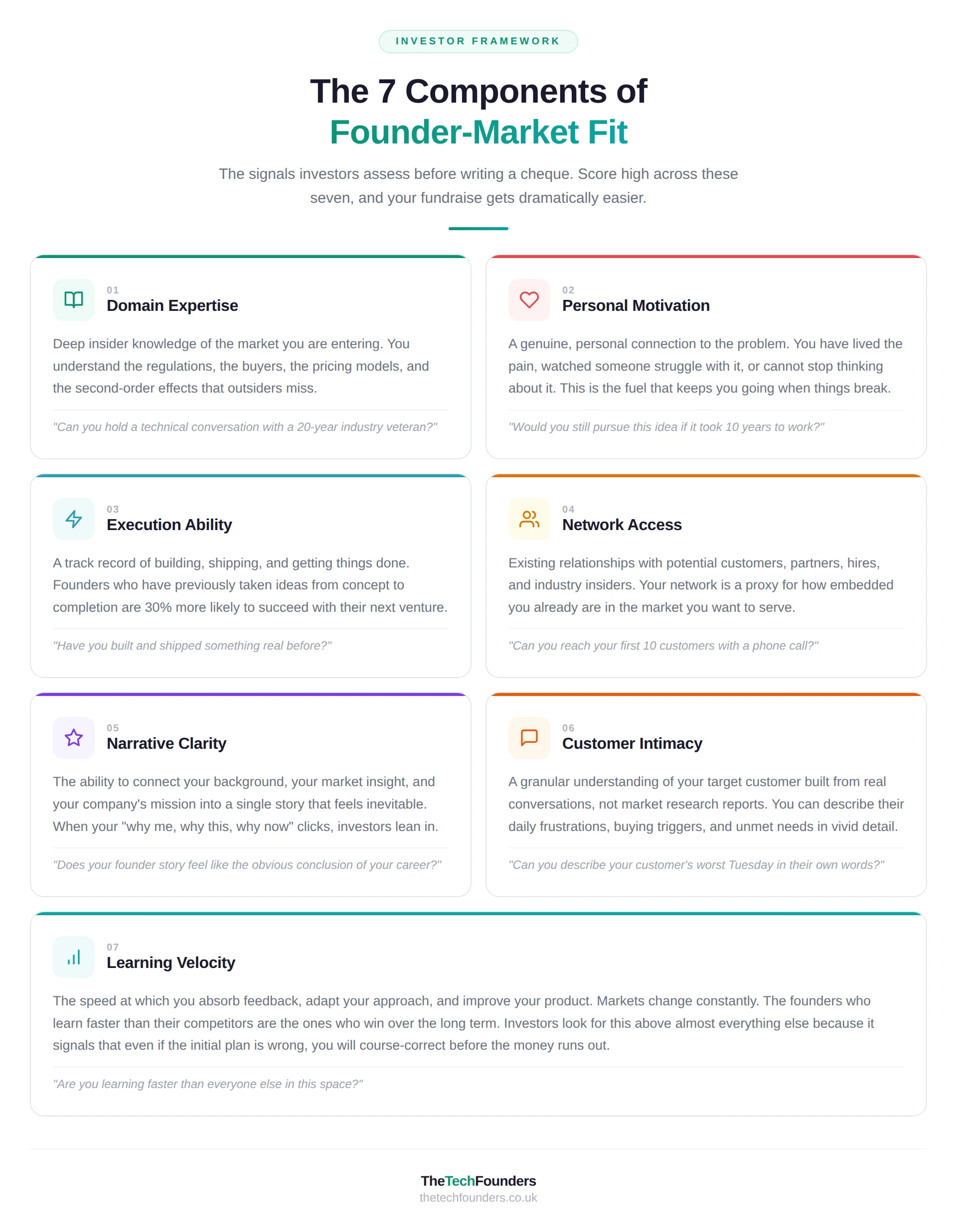
Founder-market fit is not a single trait. It is a combination of factors that investors assess, sometimes consciously and sometimes instinctively. Here are the seven components that matter most.
Domain expertise
Do you understand the market from the inside? This does not necessarily mean you worked in the industry for 20 years, although that helps. It means you have a level of understanding that lets you see patterns, spot opportunities, and avoid the mistakes that outsiders make.
A useful test: can you have a technical conversation with someone who has spent their career in this space, and hold your own?
Personal motivation
Why this problem? Why now? The strongest founders have a story that connects them personally to the market. Maybe they experienced the pain point themselves. Maybe they watched a family member or colleague struggle with it. Maybe they worked on the problem in a previous role and became obsessed with solving it properly.
Investors can tell the difference between a founder who picked a market because a trend report said it was hot and a founder who cannot sleep because the problem bothers them so much.
Execution ability
Ideas are cheap. Execution is everything. Have you built something before? Have you shipped a product, led a team, or taken a project from concept to completion? Your track record of execution, especially within a related domain, is one of the strongest signals investors look for.
Data supports this. Founders with a successful track record have roughly a 30% chance of success with their next venture, compared to 18% for first-timers.
Network access
Can you pick up the phone and reach your first 10 customers? Do you know the key players in your market? Can you recruit talent who understands the space?
Your existing relationships are a proxy for how embedded you are in the market. A founder who already has relationships with potential customers, partners, and hires has a massive head start over one who is starting from zero.
Narrative clarity
Can you explain why you, why this problem, and why now in a way that feels inevitable? The best founder stories do not sound rehearsed. They sound like the obvious conclusion of everything the founder has done in their career.
When your personal story, your market insight, and your company's mission all connect into a single narrative, it creates a sense of inevitability that is incredibly powerful in fundraising conversations.
Customer intimacy
How well do you actually know your target customer? Not from market research reports, but from real conversations, observations, and shared experiences. The founders who build the best products are the ones who can describe their customer's daily frustrations in granular detail.
Learning velocity
Markets change. Products need to evolve. The founders who succeed over the long term are the ones who learn faster than everyone else. Investors look for evidence that you can absorb feedback, adapt your approach, and improve your product faster than the competition.
How investors actually evaluate founder-market fit
Most investors will never hand you a scorecard, but they are running one in their heads. Within the first 10 minutes of a pitch meeting, an experienced investor is mentally scoring you across the components above.
Here is roughly how it works. They are looking for signals in three areas.
Your backstory. Does your career, education, or personal experience connect logically to the market you are entering? If you spent a decade in financial services and you are building a fintech product, that is a strong signal. If you were a marketing consultant last month and now you are pitching an AI healthcare platform, they will have questions.
Your depth of insight. Can you talk about the market with a level of detail that goes beyond what is publicly available? Do you understand the second and third-order effects of market dynamics? Can you explain why existing solutions fail in ways that are not obvious?
Your energy and conviction. Is this something you are genuinely passionate about, or does it feel like you are pitching a business plan you wrote last weekend? Investors meet hundreds of founders every year. They can tell when someone is performing enthusiasm versus when someone is genuinely obsessed.
The pitch deck might get you the meeting. But it is the founder-market fit that closes the deal.
Founder-market fit and fundraising
Let us be direct about why this matters so much in a fundraising context.
At the pre-seed and seed stages, founder-market fit is often the deciding factor. When two startups are pitching similar ideas in similar markets, the one with stronger founder-market fit will almost always win the funding.
This is because founder-market fit reduces perceived risk for the investor. A founder who deeply understands their market is less likely to build the wrong product, less likely to misjudge the competitive landscape, and less likely to give up when things get difficult. For an investor writing a cheque based largely on trust, these signals matter enormously.
Founder-market fit also affects the terms you get. Founders with strong market alignment tend to raise at higher valuations because investors see them as lower risk. They also tend to close rounds faster because the due diligence process is smoother when the founder can answer deep market questions with confidence.
And it works the other way too. A weak founder-market fit is one of the most common reasons investors pass on a deal. Even if the market is attractive and the product idea is sound, if the investor does not believe the founder is the right person to execute, the answer will be no.
Real-world examples: when founder-market fit works
The best way to understand founder-market fit is to look at founders who had it.
Nik Storonsky, Revolut. Before founding what is now a $75 billion fintech company, Storonsky was an equity derivatives trader at Lehman Brothers and Credit Suisse. He understood FX fees, cross-border payments, and banking infrastructure from the inside. The pain point that inspired Revolut, being overcharged on currency exchange while travelling, was something he experienced firsthand. His co-founder Vlad Yatsenko was a software architect specialising in core banking systems at UBS and Deutsche Bank. Together, they had the exact combination of financial markets knowledge and technical execution ability needed to build a global financial super-app.
Anne Boden, Starling Bank. Boden spent 30 years in traditional banking, including serving as COO at Allied Irish Banks, before founding Starling. Her deep understanding of how banks actually work, and where they fail their customers, gave her the insight to build a genuinely different digital bank. Starling has reported three consecutive years of profitability, a rarity among challenger banks.
Oliver and Alexander Kent-Braham, Marshmallow. The twin brothers founded Marshmallow to provide fairer car insurance for people who have moved to the UK. Their motivation was personal. Their family had immigrated to the UK and experienced the unfairly high insurance premiums that newcomers face. That personal pain point, combined with their understanding of how insurance pricing works, drove them to build a company now valued at over $2 billion.
Vishal Marria, Quantexa. Before founding Quantexa, Marria spent years at Ernst & Young leading financial crime analytics. He understood precisely how banks struggled with data fragmentation when trying to detect fraud and money laundering. Quantexa, now valued at $2.6 billion, builds the decision intelligence platform he wished existed when he was working at EY.
Bracket (Alex Charles, Pierre Anderson, Martin Lee). The three co-founders of Bracket bring a combined 30+ years of experience in FX and treasury operations. They had seen firsthand how mid-market companies were managing billions in currency transactions using spreadsheets and manual processes. That deep industry knowledge helped them secure a $7 million seed round led by Macquarie Group, a customer-turned-investor, and Blackfinch Ventures.
The pattern is consistent. Founders who have lived inside the problem they are solving build better products, attract stronger investors, and scale faster.
Can you build founder-market fit if you do not have it yet?
Yes. Founder-market fit is not a binary yes or no. It exists on a spectrum, and it can be developed over time.
Here is how.
Bring on a co-founder who has it. If you are a technical founder entering a market you do not know deeply, find a co-founder who does. Complementary founding teams where one person brings the domain expertise and the other brings the technical or product skills are often viewed more favourably by investors than a solo founder trying to do everything.
Immerse yourself in the market. Attend industry events. Join relevant communities. Talk to potential customers. Not 5 conversations. Fifty. A hundred. The goal is to develop the kind of intuitive understanding that only comes from deep immersion.
Build in public. Write about the problems you are discovering. Share insights from customer conversations. Create content that demonstrates your growing expertise. A thoughtful blog post or a well-researched LinkedIn article can carry surprising weight with investors, especially if it shows genuine insight rather than surface-level commentary.
Start with a specific wedge. You do not need to understand the entire market on day one. Find a narrow problem within the market that you can become the expert on. Solve that problem well, and your credibility will expand naturally.
Get operational experience. If you are serious about a market but lack direct experience, consider working in it first. Even a six-month stint at a company in the space can give you the insider knowledge and network access that transforms your founder story.
The founders at early-stage AI accelerators in the UK often use these programmes specifically to build founder-market fit through mentorship, customer access, and market immersion.
Founder-market fit vs product-market fit
These two concepts are related but different, and the timing matters.
Founder-market fit comes first. It is about whether the right person is working on the right problem. It exists before the product is built, before there are customers, and before there is revenue.
Product-market fit comes later. It is about whether the product you have built meets genuine market demand. You measure it through customer retention, growth metrics, and the famous Sean Ellis test: would more than 40% of your users be "very disappointed" if your product disappeared?
Here is the connection. Founder-market fit makes product-market fit more likely. When a founder deeply understands their market, they build better products faster, iterate more intelligently, and waste less time on features nobody wants. The founder's alignment with the market is the engine that drives the company toward product-market fit.
You can think of it as a sequence. Founder-market fit is the seed. Product-market fit is the harvest. Without the right seed, no amount of watering will produce the crop you want.
If you are building a startup in the UK, here is what you should take away from this.
Audit your own fit honestly. Before you start fundraising, score yourself across the seven components. Where are you strong? Where are the gaps? Being honest with yourself now will save you from uncomfortable conversations with investors later.
Lead with your story. When you pitch, do not start with the market size. Start with why you are the person who has to solve this problem. Connect your personal experience, your domain knowledge, and your motivation into a narrative that feels inevitable.
Address gaps proactively. If your founder-market fit has weaknesses, name them before the investor does. Explain what you are doing to close the gap, whether that is a co-founder hire, an advisory board, or an immersion strategy. Self-awareness is itself a strong signal.
Remember that fit can be built. You do not need to have spent 20 years in an industry to have founder-market fit. What you need is genuine obsession with the problem, a credible path to deep understanding, and the learning velocity to close knowledge gaps faster than your competition.
Use UK ecosystem advantages. The UK has one of the strongest startup ecosystems in the world, with accelerators, incubators, and industry networks that can help you build founder-market fit. Use them.
Building a tech startup in the UK? The Tech Founders covers funding rounds, founder stories, and practical guides to help you navigate your journey.
Related guides: