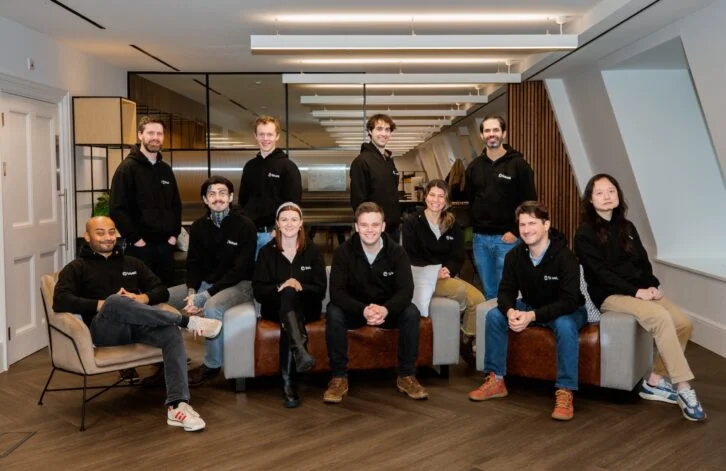

Asymmetric Security, a London and San Francisco-based cybersecurity startup, has raised $4.2 million in an oversubscribed pre-seed round to build AI agents that automate digital forensics and incident response.
The round was led by Susa Ventures, with participation from Halcyon Ventures and Overlook Ventures.
The round also includes an impressive roster of angel investors: Meta's Charlie Songhurst, Entrepreneur First co-founder Matt Clifford, and former Y Combinator president Geoff Ralston.
What Asymmetric Security Does
Asymmetric Security is an AI-native cyber forensics startup that combines frontier AI models with human forensics experts. Their platform automates large parts of the investigation process, shrinking response times from days to hours.
The platform has already accelerated responses for over 100 attacks, improving speed, accuracy, and cost efficiency. Key features include rapid log pulls, AI-powered investigation, human-in-the-loop validation, and defensive recommendations.
"As AI progress accelerates toward AGI, the security stakes rise," says Alexis Carlier, CEO and co-founder. "Autonomous AI attacks are no longer hypothetical, and AI model weight theft is now one of the most consequential security risks facing the West. We exist to accelerate AI cyberdefence and make AI an overwhelming advantage for defenders."
The Founders
The founding team brings together three co-founders with unusually relevant backgrounds.
Alexis Carlier (CEO) comes from the world of AI governance and policy. He co-founded the Centre for the Governance of AI (GovAI), one of the world's leading AI think tanks. He also led AI security programmes at RAND and the University of Oxford.
Zainab Ali Majid spent over five years as a cybersecurity analyst at Stroz Friedberg (now part of Aon), where she investigated some of the largest cybersecurity breaches of the past decade, including Cambridge Analytica. She has also published research at NeurIPS on AI cybersecurity evaluations.
Pippa Thompson rounds out the founding team as the third co-founder.
The Problem: $55 Billion Lost to BEC Attacks
Business Email Compromise (BEC) attacks, where criminals impersonate executives or vendors to trick employees into transferring money, account for the majority of reported cyber incidents worldwide. Over the past decade, these attacks have caused more than $55 billion in losses.
With AI now able to imitate human actions quickly, these attacks are happening faster, costing less to execute, and becoming tougher to trace. Many companies still use slow, manual methods to investigate, which can take days or weeks.
For UK tech startups scaling rapidly, the challenge is that traditional DFIR (Digital Forensics and Incident Response) services are expensive and slow. AI-powered incident response could change the economics entirely.
What's Next
Asymmetric Security plans to use the funding to expand its engineering and incident response teams. Over the next year, the company also intends to widen its services to cover insider threats, ransomware attacks, and nation-state-level incidents.
"We believe in the full-stack AI services thesis," said Chad Byers, co-founder and general partner at Susa Ventures. "Asymmetric is the best company in the cyber incident response market, with a rare combination of incident response and AI expertise. Their cybersecurity services business is compelling on its own, but it also gives them a powerful distribution channel into the enterprise security market."
The Bigger Picture
Asymmetric Security is entering a market that's heating up rapidly. Cybersecurity startup investment hit $18 billion globally in 2025, up 26% from the previous year, with early-stage funding particularly strong.
For UK founders watching the AI investment landscape, Asymmetric Security represents an interesting model: deep domain expertise combined with cutting-edge AI, applied to a problem that enterprises desperately need solved.
Building a tech startup in the UK? Join The Tech Founders community for more funding news and guides on growing your business.