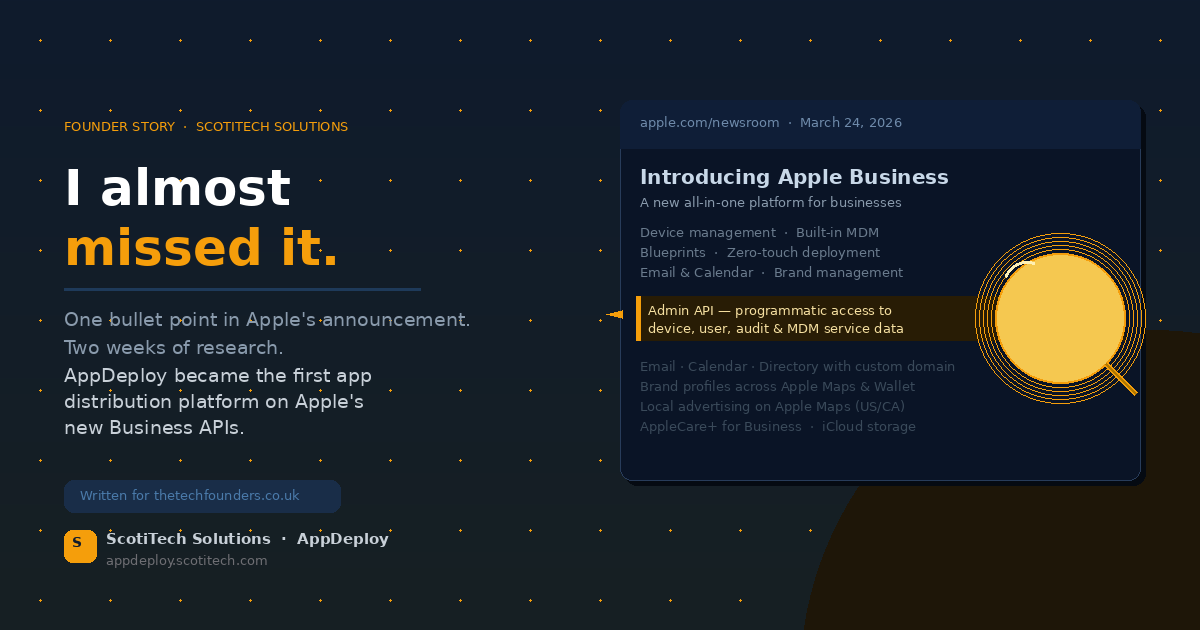

I almost missed it.
Apple launched a new platform called Apple Business on April 14. Most of the coverage focused on the brand story — three products merging into one, new email and calendar features, Maps integration for local businesses.
But buried in the announcement was a single line: Admin API. Programmatic access to device, user, audit, and MDM service data.
I'd been heads-down on other things. I nearly scrolled past it.
I didn't. And that decision is now the centrepiece of AppDeploy's 2026 roadmap.
Some context. AppDeploy is ScotiTech's enterprise mobile app distribution platform — we help companies deploy and manage iOS and Android apps across their device fleets without the complexity of traditional MDM setups.
When I saw the Apple Business API announcement, my first instinct was: has anyone built on this yet?
So I spent the next two weeks going through competitor documentation. Applivery, Appcircle, Firebase App Distribution, every distribution platform I could find. Nothing. Not one of them had touched it.
Then I found a post on the Jamf community forum — Jamf being the $2.2B market leader in Apple device management — from a senior Jamf Heroes-badged admin, posted on April 14 itself:
"I'm drooling at the user options for scoping purposes. Been waiting forever for these to appear."
— Jamf Heroes community member, April 14, 2026 · https://community.jamf.com/general-discussions-2/apple-business-api-endpoints-58100
That was all I needed. If the people whose entire job is managing Apple devices professionally were discovering these APIs in real time, the window was genuinely open.
As a founder you get very few moments where you can see a gap that's genuinely open — not just underserved, but completely untouched. This was one of them.
The honest version of what happened next: we moved fast. We cancelled two other things we'd planned for Q2. We started building on the Apple Business APIs immediately.
Here's what the API actually unlocks that nobody in app distribution had built before:
→ Live device inventory. One API call pulls every enrolled Apple device in an organisation — model, OS version, MDM assignment, serial number — directly into your platform. No CSV exports. No manual portal navigation.
→ MDM-agnostic routing. You can read which MDM server each device is assigned to — Jamf, Intune, Kandji, Mosyle — and route app deployments accordingly. A distribution platform that works across mixed MDM environments without asking the customer to standardise first.
→ Bulk assignment automation. When a company onboards 50 new iPhones, they get assigned to the right MDM server and queued for app deployment automatically. No IT intervention required.
And then at WWDC 2026 this week, Apple went further — new APIs for Blueprints and Configurations, user and group management, app licence information, and audit events.
The Blueprints API is the one that changes everything. You can now programmatically bundle an app with its full configuration so it lands on an employee's device the moment they unbox it. Zero IT setup. Zero touch. App deployed before day one.
AppDeploy is live as — as far as we can tell — the first enterprise app distribution platform with native Apple Business integration:
✓ Live fleet visibility — every enrolled Apple device synced directly from Apple Business
✓ MDM-aware routing — deployments routed correctly across Jamf, Intune, Kandji without touching the customer's MDM setup
✓ Group-based distribution — app versions targeted to Apple Business user groups automatically
Blueprint-based zero-touch deployment and audit-ready compliance exports — built on the new WWDC 2026 APIs — are next on the roadmap.
None of this requires customers to change their MDM. AppDeploy sits on top of Apple Business and whatever MDM they already have — and adds the one thing neither provides alone: a clear view of which app is on which device, which version, and what needs to happen next.
A few things I'd share with other founders from this experience:
Read the footnotes
The headline is never where the opportunity is. Apple's headline was "unified business platform." The opportunity was four words in a bullet point: Admin API.
Move before you're certain
We didn't do six months of customer discovery on this. We saw the gap, validated that no competitor had moved, and built. In fast-moving platform ecosystems, speed of conviction matters more than certainty.
First-mover windows are real but short
Large platforms are slow, but they're not blind. We have maybe 12–18 months before Applivery or someone similar wakes up to this. That clock started in April.
Being smaller is the advantage
We made this call and started building within a week of the announcement. A 500-person company couldn't have done that.
Founder · ScotiTech Solutions Limited
If you're building in the Apple enterprise space, or you're a UK founder who's spotted a similar platform gap and want to compare notes — I'd love to connect.