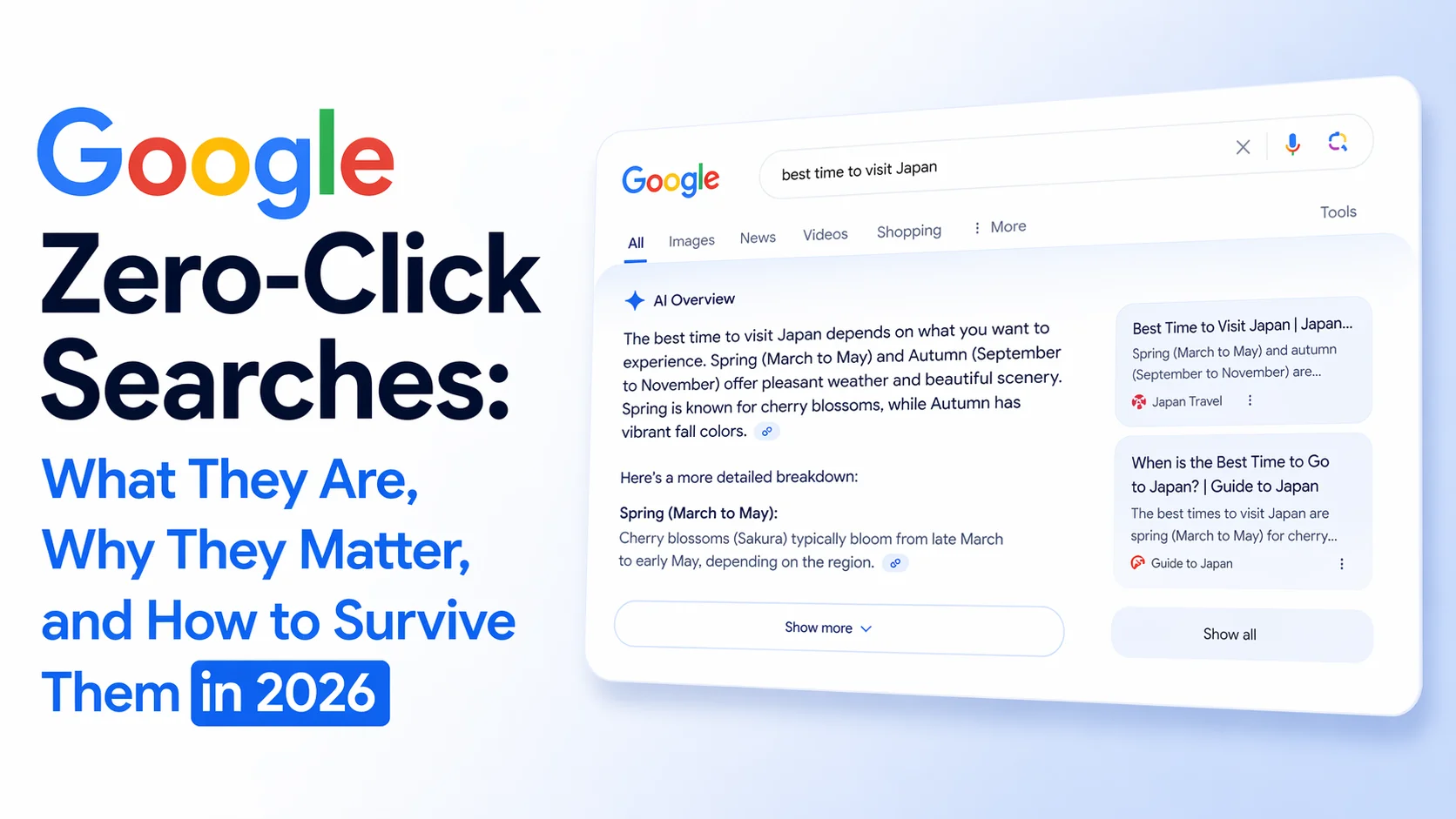

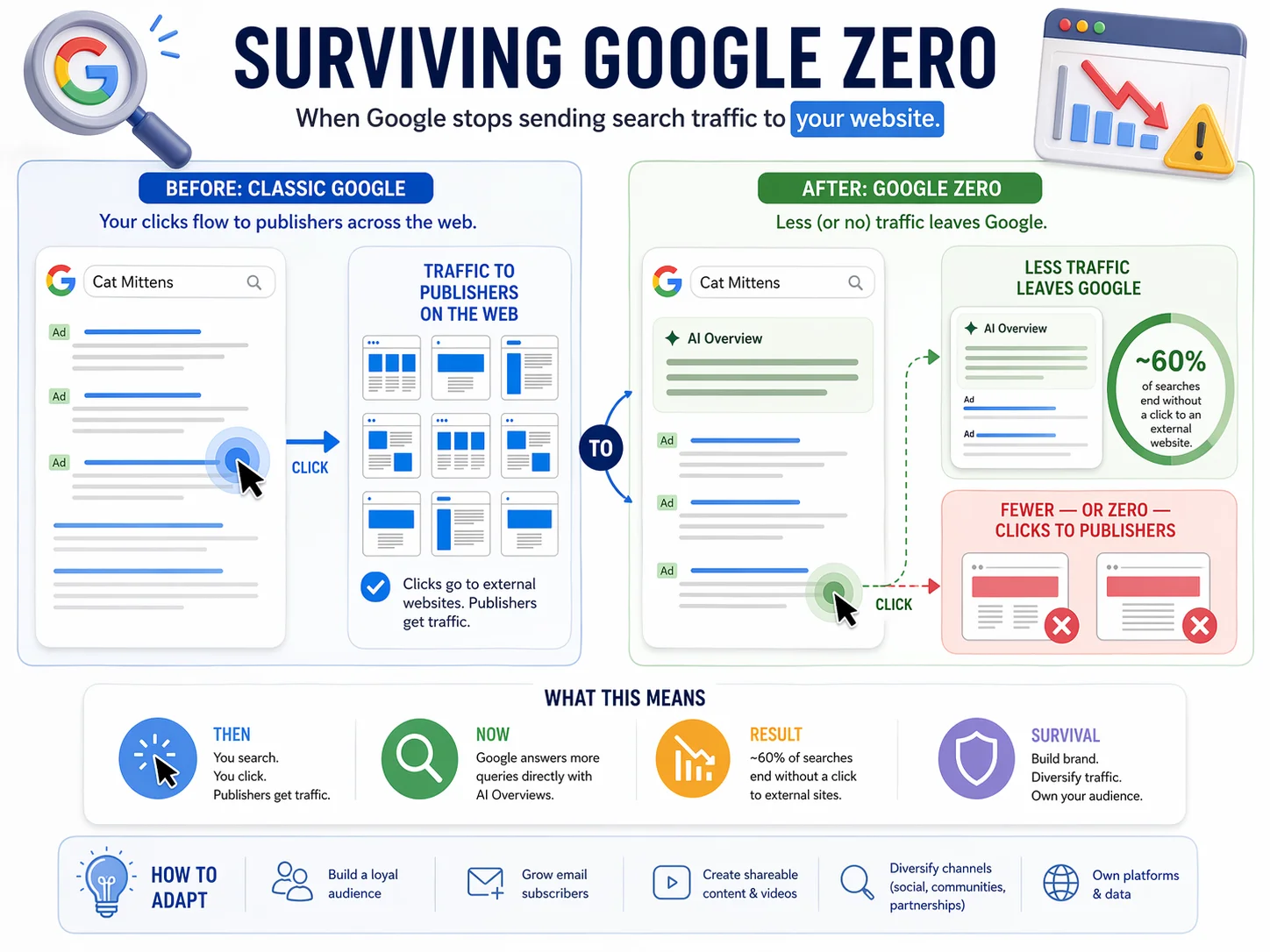
Nearly 60% of all Google searches now end without a user clicking through to any website. The search engine that built the modern internet is quietly dismantling the traffic model that millions of businesses depend on. This is not a prediction. It is already happening, and the pace is accelerating.
The term "Google Zero" was coined by Nilay Patel at The Verge to describe a future where Google stops sending meaningful traffic to third-party websites. That future arrived faster than most anticipated. According to data from Datos and SparkToro, approximately 58.5% of US Google searches and 59.7% of EU searches ended without a click in 2024. With Google's AI Overviews expanding, AI Mode rolling out across markets, and platforms like ChatGPT and Perplexity gaining search share, the trend is heading in one direction.
For startup founders, content marketers, and anyone who relies on organic search traffic to grow a business, this is the most important shift in digital marketing since mobile overtook desktop. This guide covers what zero-click searches are, why they are growing, the hard data behind the trend, how to prepare your strategy, what types of content will survive, and what will not.
What exactly is a zero-click search?
A zero-click search happens when a user types a query into Google and gets their answer directly on the search results page, without clicking through to any website. The user's question is answered. Google keeps the visitor. Your website gets nothing.
Google delivers these instant answers through a range of features that have expanded rapidly over the past five years: AI Overviews (formerly Search Generative Experience), featured snippets, knowledge panels, People Also Ask boxes, local packs showing maps and business information, image and video carousels, and direct answer boxes for calculations, conversions, and factual queries.
The concept is not new. Google has been reducing its dependence on external websites for years. Knowledge panels appeared in 2012. Featured snippets followed in 2014.
But the introduction of AI Overviews in May 2024, and the subsequent launch of AI Mode in the US and UK in 2025, represents something qualitatively different. Google is no longer just extracting snippets from web pages. It is synthesising information from multiple sources into conversational answers that often eliminate any reason to click.
How big is the zero-click problem? The data founders need to see
The numbers paint a clear picture of where search is heading.
According to the SparkToro and Datos 2024 study, for every 1,000 Google searches in the US, only 374 clicks go to the open web. In the EU, that number drops to 360. The rest either end on the search results page itself, or route users to other Google-owned properties like YouTube, Google Maps, or Google Shopping.
Bain & Company's research, conducted in partnership with Dynata in December 2024, found that roughly 80% of consumers now rely on AI-generated summaries for at least 40% of their searches. That survey covered over 1,100 consumers and found that even among people who say they are sceptical of generative AI, about half admit that most of their queries are answered on the search page without a click.
The Semrush study from March 2025 showed AI Overviews being triggered on 13.14% of all queries, up from 6.49% just two months earlier in January 2025. That is a doubling in eight weeks. On mobile, the problem is worse. Nearly 60% of Google mobile searches now end without a click, according to Search Engine Land's analysis.
Meanwhile, AI-native search platforms are growing fast. ChatGPT saw a 44% traffic increase in November 2024. Perplexity reached 15 million monthly users by late 2024. Bain's survey found that between 40% and 70% of LLM users are already using these platforms for tasks that previously went to Google, including research (68%), news (48%), and shopping recommendations (42%).
The traffic your website used to get from informational queries is being eaten from both sides. Google is answering more queries itself, and users are increasingly going to AI tools that may never send a click your way at all.
Why are zero-click searches growing so fast?
Two forces are driving this acceleration, and they are reinforcing each other.
The first is Google's own evolution. Google has spent years building features that keep users on its results page. Knowledge panels, featured snippets, People Also Ask boxes, local packs, and shopping carousels were all steps in this direction. AI Overviews are the culmination of that strategy. Instead of pulling a single snippet from one website, Google's AI now synthesises information from multiple sources into a coherent answer. The user gets what they need. The websites that provided the underlying information get a small citation link at best.
Google's AI Mode, which launched in the UK in July 2025, takes this further. It replaces the traditional search page entirely with a conversational interface that generates answers by pulling from across the web. Users can ask follow-up questions, refine their queries, and get detailed responses without ever seeing a traditional list of blue links. As Jellyfish Training's Chris Hutty noted, AI Mode makes Google behave more like a conversational assistant than a search engine.
The second force is the rise of AI-native search platforms. ChatGPT Search, Perplexity, and Google's own Gemini are training users to expect synthesised, conversational answers rather than a list of links. Once users experience getting a complete answer in one place, going back to clicking through five different websites feels inefficient. This behaviour shift is permanent. Users do not unlearn convenience.
For startup founders building products and content strategies, this matters because the customer acquisition playbook that worked from 2010 to 2023, publish content targeting keywords, rank in Google, get traffic, convert visitors, is breaking down. Not dying entirely. But breaking down enough that relying on it as your primary growth channel is increasingly risky.
What types of searches are most affected?
Not all searches are equal in the zero-click world. Understanding which queries are losing clicks and which are holding up is the difference between a smart content strategy and a wasted one.
Informational queries are hit hardest. Questions like "what is a CRM," or "how to register a company in the UK, are exactly the type of content AI Overviews were built to answer. If your blog strategy centres on answering these kinds of questions, your traffic is almost certainly declining or about to.
Local searches operate differently. Google's local pack, showing maps, business hours, reviews, and contact information, has been a zero-click feature for years. Users can call a business, get directions, or read reviews without visiting the business's website. For local service businesses, the Google Business Profile has effectively replaced the website as the primary digital shopfront.
Navigational queries, where users are searching for a specific brand or website, remain relatively stable. If someone types "Stripe pricing" or "Notion templates," they want to go to that specific site. Google still sends those clicks through.
Transactional and commercial queries are complicated. Google Shopping, product carousels, and price comparison features answer some purchase-intent queries directly. But for complex purchases, users still click through to compare options, read reviews, and make decisions. These queries still drive traffic, but the competition for them is fierce.
The pattern is clear. The more generic and informational your content, the more vulnerable it is. The more specific, proprietary, and action-oriented your content, the more likely it is to survive.
What SERP features are driving zero-click behaviour?
Understanding the specific Google features that prevent clicks helps you decide where to compete and where to redirect your efforts.
AI Overviews are the biggest driver of the current acceleration. Google's AI synthesises information from multiple web pages into a single conversational answer. AI Overviews now appear on approximately 30% of informational queries, according to analysis by Don Creative Group. Unlike featured snippets, which at least linked prominently to one source, AI Overviews blend multiple sources together and often provide such complete answers that users have no reason to click anywhere.
Featured snippets trained users to expect instant answers. They appear above organic results in what became known as "position zero." For years, winning a featured snippet was a major SEO victory. Featured snippets also feed voice assistants. According to a Backlinko study, 40.7% of voice search answers pull directly from featured snippets, meaning your content can become the definitive answer without any attribution or brand mention.
Knowledge panels show structured information about entities, people, businesses, and places. They pull from Wikipedia, Wikidata, Google Business Profiles, and other trusted sources. Users get the facts they need without clicking.
People Also Ask boxes appear in 78% of search results, according to Nozzle data. Each expandable question reveals an answer pulled from a web page. Users can explore multiple related questions without leaving the search results.
Local packs show the top three local businesses with map pins, ratings, hours, and contact details. For service-based businesses, appearing in the local three-pack is now more valuable than ranking number one in organic results.
Direct answer boxes handle calculations, conversions, weather, sports scores, and simple factual queries. Google answers these from its own data. No external website is involved at all.
How is zero-click search reshaping SEO and marketing?
The old model of "rank well and wait for the traffic" is no longer enough. SEO professionals are facing a measurement crisis where traditional metrics, clicks, click-through rates, and organic traffic graphs, no longer tell the full story.
You might rank number one for a high-value keyword, but if an AI Overview sits above your listing and answers the query completely, your traffic from that keyword could drop 20% or more. Meanwhile, your content is being consumed by millions of users who never visit your site, never see your calls to action, and never enter your conversion funnel.
This creates a difficult conversation for founders and marketers. If your content powers AI responses but generates no direct traffic, what is its actual business value? At best, it is brand awareness. At worst, it is free labour for Google's answer engine.
The shift demands new thinking across several dimensions. First, metrics. Search Engine Land's analysis suggests tracking AI visibility scores, SERP feature share, and entity association strength alongside traditional traffic metrics. Semrush recommends monitoring your visibility across AI platforms including Google AI Overviews, ChatGPT, and Perplexity, not just Google's organic results.
Second, content strategy. The founder-led content approach becomes even more important in a zero-click world. When generic informational content gets absorbed by AI, the content that stands out is content with a human face, a unique perspective, and proprietary data that AI cannot replicate.
Third, channel diversification. If Google is sending less traffic, you need other channels. Email lists, communities, social platforms, podcasts, and video all become more important. The startups that are growing fastest right now, companies like Lovable and Gamma, are not dependent on Google traffic. They are building audiences through founder-led content and community engagement.
How should founders and marketers prepare for zero-click search?
The preparation strategy splits into two tracks: immediate technical actions that protect your existing visibility, and strategic shifts that position your business for the long term.
Immediate technical actions
Optimise your content for AI retrieval. Structure your pages so AI systems can extract clear, authoritative answers. Start articles with concise answers in the first 40 to 60 words. Use headings written as standalone search queries ("How much does a UK Skilled Worker visa cost?") rather than generic labels ("Costs"). Keep paragraphs to two or three sentences maximum. AI systems extract passages, not full articles. Short paragraphs extract cleanly.
Add structured data to every page. Schema markup helps Google and AI systems understand your content. FAQ schema, HowTo schema, Article and NewsArticle schema, and LocalBusiness schema all increase your chances of appearing in SERP features and AI Overviews. Test your markup with Google's Rich Results testing tool.
Ensure AI crawlers can access your content. Check your robots.txt to confirm that GPTBot (OpenAI), ClaudeBot (Anthropic), and PerplexityBot are not blocked. If AI systems cannot crawl your content, they cannot cite it. This is something every UK startup website should check immediately.
Build entity signals. Google's Knowledge Graph maps relationships between entities. Make sure your brand, your founders, and your products are clearly defined entities with consistent information across your website, LinkedIn profiles, Wikipedia (if relevant), and Google Business Profile. Use SameAs schema to connect your brand's digital presence.
Strategic shifts for the long term
Build an owned audience. The single most effective defence against zero-click search is an audience that comes directly to you, not through Google. Email newsletters, SMS lists, and communities are Google-proof distribution channels. As Cyrus Shepard at Zyppy noted in his analysis of content types that survive the zero-click era, owned audience is the gold standard. Publications like Morning Brew and Stratechery do not depend on Google for their traffic because their audience has opted in.
Invest in original research and proprietary data. AI can summarise existing information, but it cannot generate original data. If you produce unique research, surveys, or datasets, AI systems will cite you rather than replace you. Companies like ChartMogul, Carta, and Orbit Media have built significant authority through original research that gets cited by journalists, analysts, and AI systems alike.
Create transaction pages that complete actions. Pages where users can book, buy, subscribe, or sign up remain among the strongest zero-click-resistant content on the web. Even as agentic commerce develops, AI agents will still need destination pages to complete transactions.
Shift your measurement framework. Stop relying solely on clicks and traffic as proof of SEO value. Track impressions, SERP feature appearances, brand mentions in AI responses, and conversion metrics from your commercial pages. Filter your reporting to focus on pages that generate revenue, leads, and conversions rather than vanity traffic metrics. As Search Engine Land put it, ten contact forms with a qualified £10,000 opportunity is a better story than "clicks up 57% this week."
Diversify across platforms. Your brand needs to be present wherever AI systems pull their information. That means maintaining active profiles on YouTube, LinkedIn, Reddit, and industry-specific communities. Perplexity cites Reddit content in nearly half of its results. ChatGPT uses social sentiment as a ranking signal. Google AIO pulls from structured content across the web. Being visible across all three citation ecosystems is now a requirement, not a bonus.
What types of content will survive the zero-click era?
Cyrus Shepard's Zyppy Signal analysis of hundreds of winning and losing websites identified 17 content types that perform well in the current environment. The pattern across all of them is consistent: content that wins is proprietary, experience-based, niche-focused, and helps users complete tasks rather than just consume information.
The strongest content types fall into clear tiers.
Very strong: owned audience and transaction pages. These are the most resilient because they do not depend on Google at all. An email newsletter with 50,000 subscribers will deliver readers regardless of what Google does with its AI features. A booking page for a hotel or a product page for an e-commerce store serves a function that AI summaries cannot replace. Users still need somewhere to complete the action.
Strong: original research, communities, creator content, and in-depth reviews. Original research generates citations from journalists, analysts, and AI systems. UGC communities like Mumsnet Talk and Flyertalk generate experience-based content that Google favours, and members seek them out directly. Creator-driven video and podcast content builds audiences that search for the host by name. In-depth reviews with first-hand testing, teardowns, and comparisons provide evidence that AI can summarise but cannot replicate.
Moderate: directories, expert perspectives, templates, and case studies. These work when built with proprietary data and genuine expertise. A generic directory will fail. A directory built on first-party data with regular updates, like AlternativeTo or Clutch, still performs. Expert perspectives backed by insider knowledge earn citations and build brand authority. Case studies showing clear before-and-after results with metrics support conversions even if they do not drive much search traffic directly.
Weak but survivable: guides, FAQs, and curated lists. These are the most vulnerable to AI summarisation. A guide explaining "what is a CRM" will lose to AI Overviews. But a guide backed by proprietary data, unique workflows, and expert insights, like Examine's evidence-graded supplement research, can still earn traffic because users want the full depth that an AI summary cannot provide. FAQs and glossaries work when they establish canonical definitions for an industry. When you think DNS, you think Cloudflare's explainer, not an AI Overview.
The common thread across all surviving content is differentiation. If AI can fully replicate what your content offers, your content will lose traffic. If your content does something AI cannot, whether that is original data, first-hand testing, expert opinion, community interaction, or task completion, it will survive.
What content will not survive?
Generic blog posts written primarily to rank for keywords are the clearest casualties. The "content marketing" playbook of the 2010s, publish 1,500-word articles targeting mid-funnel informational keywords, build links, and wait for traffic, is collapsing.
Content that merely restates publicly available information in slightly different words is exactly what AI Overviews were built to replace. If your article on "how to set up a limited company in the UK" does not contain anything beyond what Companies House and Gov.uk already publish, AI will answer that query using those sources directly and your page becomes redundant.
Commodity news reporting is also under pressure. Outlets that rewrite press releases without adding original analysis, commentary, or exclusive information are losing traffic to AI summaries. The Reuters Institute reported a steady year-on-year decline in Google search traffic for news publishers. Only original reporting that is fast, in-depth, or exclusive can still earn citations and visits.
Shallow "best of" lists and roundup posts are failing too. Marketers have used fake lists to manipulate AI-generated recommendations, and Google is cracking down. Lists that survive require original testing, published scoring criteria, and genuine expertise in the niche.
Expert view: what this means for UK tech founders
By Vijay, Co-Founder, GrowthCart
I have been working in digital marketing and growth for over a decade, helping businesses across the UK build their online presence through SEO, paid acquisition, and content strategy. The zero-click shift is not something that is coming. It is something we are already navigating with clients every week.
Here is what I tell founders who ask me about this.
First, do not panic, but do not ignore it either. Google still sends billions of clicks per day. Transactional queries, brand searches, and complex commercial queries still drive real traffic. The traffic that is disappearing is primarily informational, and for most startups, informational blog traffic was never your highest-converting channel anyway.
Second, treat this as a forcing function to get serious about content quality. For too long, startups have published mediocre blog posts because "we need to do content marketing." The zero-click era kills mediocrity. If your content does not contain original data, genuine expertise, or a unique perspective, it will be absorbed by AI and you will get nothing in return. That is not a bad thing. It forces you to create content worth creating.
Third, own your audience. The single most valuable thing any startup founder can do right now is build a direct relationship with their audience that does not depend on any platform. An email list, a community, a podcast, a newsletter. If your distribution disappears when Google changes an algorithm, you never had real distribution. You had borrowed attention.
Fourth, get your technical foundations right. Schema markup, AI crawler access, entity consistency, structured content. These are not optional any more. They are the baseline for being visible in an AI-driven search environment.
And finally, remember that every disruption creates opportunity. The companies that adapt first gain an outsized advantage. While your competitors are still optimising for clicks that no longer exist, you can be building the owned audience, the original research, and the brand authority that will compound for years.
The search game has changed. But the businesses that understand the new rules are going to win bigger than ever.
Related guides: