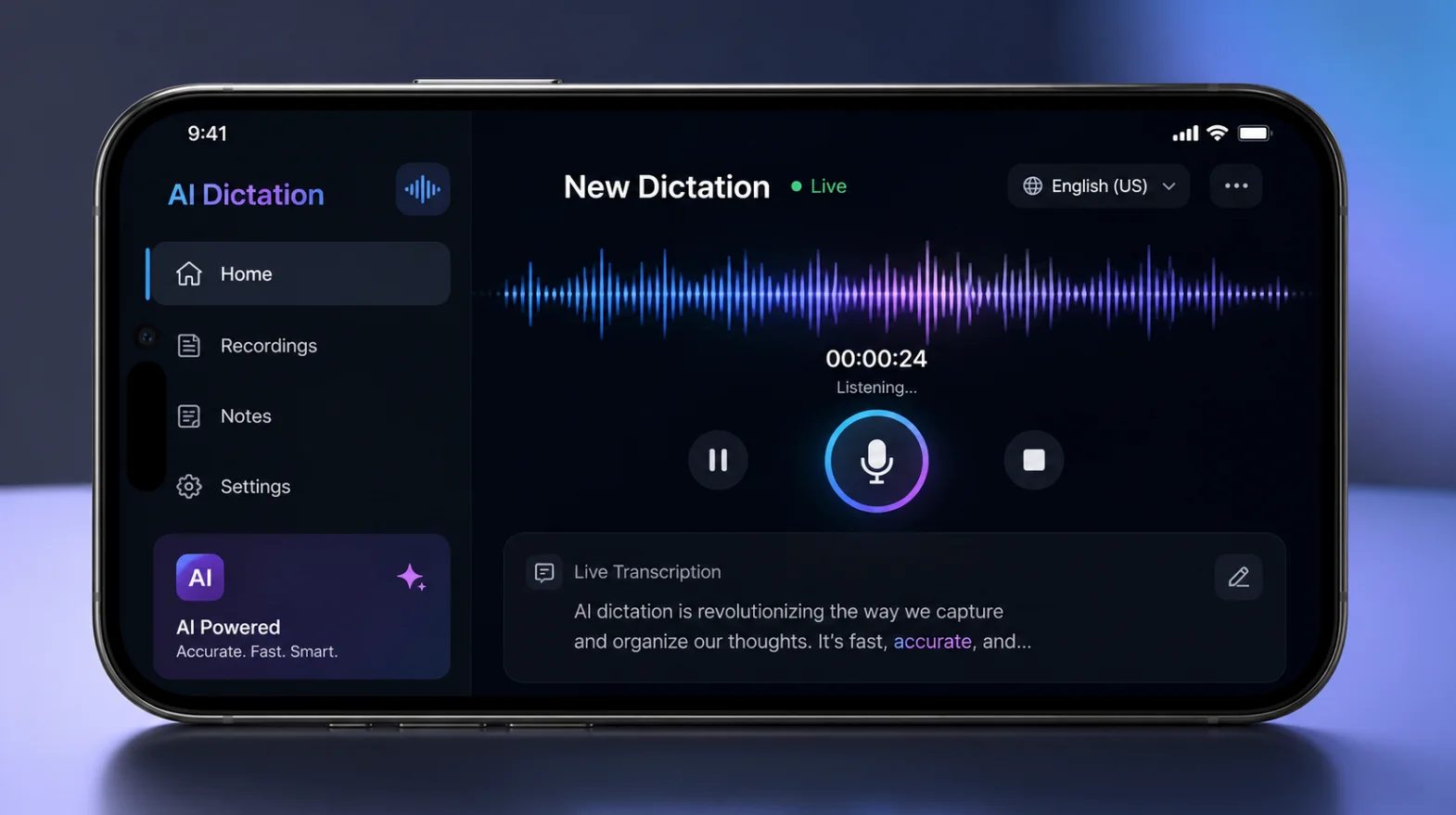

You think faster than you type. Most founders speak at around 130 to 150 words a minute and type at 40 to 60.
That gap is two to three hours of recovered time every day if you can close it.
AI dictation apps have finally crossed the line from clunky novelty to serious productivity tool. The shift from old speech recognition to modern systems built on large language models and Whisper-class transcription engines means the apps now strip filler words, fix stumbles, and format text for the app you are typing into. The output usually needs no edits.
The category has also exploded. There are now dozens of apps competing on speed, privacy, language support, and price. If you are trying to build a tech startup in the UK or anywhere else, picking the right one is worth a few minutes of homework.
Here are the 10 best AI dictation apps available right now.
What Are AI Dictation Apps?
AI dictation apps convert your speech into clean, formatted text in real time, anywhere on your computer or phone. They sit behind a hotkey or keyboard shortcut. You hold a key, speak, release, and the text appears at your cursor in whatever app you are using, whether that is Gmail, Slack, Cursor, ChatGPT, or a Word document.
The best apps go further than transcription. They remove filler words like "um" and "uh", fix repeated phrases, format lists into bullet points, and adapt the tone of the output to match the app you are writing in. A casual Slack reply comes out casual. A client email comes out polished.
1. Wispr Flow
Best for: Cross-platform power users and enterprise teams
Wispr Flow is the most funded and most polished app in the category. The company was founded in 2021 by Tanay Kothari and Sahaj Garg, originally as a hardware project to build a wearable device that could turn sub-vocal neural signals into computer input. After three years, the team pivoted to the software layer they had built, and Flow became their flagship product.
Wispr is based in San Francisco at 444 Townsend Street and has raised approximately £64 million ($81 million) across five rounds, with the most recent valuation reported at around £550 million ($700 million). Investors include Menlo Ventures, Notable Capital, NEA, and 8VC. Tanay Kothari studied computer science and AI at Stanford and made the Forbes 30 Under 30 list in 2023.
Flow runs on macOS, Windows, iOS, and Android. The Android app launched in February 2026, alongside an infrastructure rewrite that cut latency by 30 percent. It supports 104 languages, including a Hinglish model for code-switched Hindi and English speakers. The free tier gives you 2,000 words per week on desktop and 1,000 per month on iOS. Paid plans start at £12 per month.
2. Willow
Best for: Founders, engineers, and AI tool power users
Willow is the Y Combinator alumni building the founder-and-engineer segment of the dictation market. The company was founded in 2025 by Allan Guo (CEO) and Lawrence Liu (CTO), both Stanford computer science alumni who dropped out to start the company. Before settling on dictation, they spent a year pivoting through assisted living software, medical clinic tools, and AI scribes for doctors.
Willow is headquartered in San Francisco and has raised £3.6 million ($4.5 million) from Box Group, Y Combinator, Burst Capital, and a long list of operator angels including HubSpot's Dharmesh Shah, Reddit co-founder Alexis Ohanian, Instacart co-founder Max Mullen, Gusto co-founder Tomer London, and Shopify's Kaz Nejatian. The company grew 50 percent month-over-month after launch and counts Uber, Heidi Health, Gusto, and Zego as enterprise customers.
The advantage with Willow is speed. The team measures around 200 milliseconds of latency, against 700 milliseconds or more for most competitors. That difference matters most when you are mid-thought composing a complex AI prompt. The iOS app, launched in November 2025, also includes a full keyboard alongside the voice input, so you can dictate then immediately edit without switching modes.
3. Monologue
Best for: Multilingual writers inside the Apple ecosystem
Monologue is the dictation product from Every, the New York-based AI media and software studio that also publishes the Every newsletter and ships Cora, Spiral, and Sparkle. Engineer Naveen Naidu built the first version in a single weekend because he wanted a dictation app that could automatically send messages, then demoed it internally and the rest of the team switched over to it.
Every was founded around 2020 and has raised approximately £2 million ($2.6 million). Monologue itself launched publicly in September 2025. During its private beta, it was being used roughly 7,000 times a day to write more than one million words per week.
The app supports more than 100 languages and is built around code-switching. The team designed it specifically for users who weave English, Spanish, Urdu, Hindi, and other languages into the same paragraph. Privacy is strong: no audio files or transcripts are stored on Every's servers, and there is an optional local model. You can try it free for 1,000 words, then pay £8 ($10) a month standalone or £24 ($30) a month inside the full Every bundle.
4. Superwhisper
Best for: Power users who want full control over models and modes
Superwhisper is the most flexible app in the category. It was built by solo founder Neil Chudleigh, who is based in Toronto and previously co-founded the affiliate-marketing platform PartnerStack. He started Superwhisper in 2023 out of frustration with existing voice-to-text tools and a wish to bring offline AI models to Mac users.
The company operates as SuperUltra, Inc. and is bootstrapped, with no external funding. Superwhisper runs on macOS, Windows, and iOS, with Android still on the roadmap.
What sets Superwhisper apart is choice. You can run Whisper locally in tiny, base, small, medium, large, large-v2, or large-v3 variants. You can plug in NVIDIA's Parakeet model. You can use your own API keys to route output through cloud LLMs for cleanup or translation. The Modes system lets you build custom presets for different apps and writing styles. Pricing is £6.50 ($8.49) a month, £64 ($84.99) a year, or a £190 ($249.99) lifetime licence. The lifetime option is rare in this category.
5. VoiceTypr
Best for: Privacy-focused builders and Windows users
VoiceTypr is the open source, no-subscription answer to Wispr Flow and Superwhisper. It was built by Moinul Moin, a solo founder and full-stack engineer who launched it in 2025 because paying £12 a month for basic dictation did not feel right and Windows users were being ignored by the Mac-first apps.
The app runs fully offline using Whisper and Parakeet models, supports more than 99 languages, and works on both Mac and Windows. The codebase lives on GitHub under the AGPL v3 licence, so anyone can audit it, fork it, or self-host. The repository has more than 350 stars.
VoiceTypr offers a 3-day free trial and one-time licences from £27 ($35) for one device, £43 ($56) for two, or £75 ($98) for four. There are no recurring fees. The bring-your-own-API-key option for AI enhancement is useful if you want optional cloud polishing without giving up control of your data.
6. Aqua Voice
Best for: Developers writing technical content and code
Aqua Voice is the speed and accuracy specialist. The company was founded in 2023 by Finnian Brown (CEO) and Jack McIntire (CTO), with Pablo Peniche on product. Finn met Jack at Harvard, where Finn studied philosophy and Jack later dropped out. Finn is dyslexic and started using Dragon Dictation in sixth grade to write school papers, which is the personal frustration behind the company.
Aqua Voice is based in San Francisco and went through Y Combinator's Winter 2024 batch. The company raised around £400,000 ($500K) in seed funding and is profitable as a small team.
The technical claim is the lowest latency in the category. The app starts up in under 50 milliseconds and inserts text in as little as 450 milliseconds. Aqua published benchmarks showing 3.2 percent word error rate on LibriSpeech clean against Google's 5.5 percent for real-time transcription, and the team's own benchmark suggests Wispr Flow makes roughly ten times as many formatting mistakes for emails and technical writing. The free tier covers 1,000 words per month. Paid plans start at £6 ($8) per month annually and unlock 800 custom dictionary entries.
7. Handy
Best for: Linux users and anyone wanting free, fully private dictation
Handy is the no-strings-attached free option for anyone who wants to start dictating without paying or signing up for anything. The project is led by an independent developer working under the cjpais GitHub handle. It is built with Tauri, Rust, and React/TypeScript.
Handy is one of the very few dictation apps that runs on Linux as well as macOS and Windows, which makes it the default choice for the developer crowd outside the Apple and Microsoft ecosystems. It uses OpenAI's Whisper for transcription, with optional GPU acceleration, plus Parakeet V3 for CPU-only setups, and Silero VAD for silence filtering.
The app is genuinely simple. Press a configurable hotkey, speak, release, and the text is pasted into the active application. There is also a Raycast extension for managing recordings, dictionaries, and models. The codebase is MIT-licensed and entirely free. There are no premium tiers, no telemetry, and no cloud calls.
8. Typeless
Best for: Heavy daily writers wanting a generous free tier
Typeless takes the category in a more app-agnostic direction. The team describes itself as Stanford alumni and serial entrepreneurs aiming to make AI feel useful and magical in everyday work. The company is operated through Simply CA LLC out of Palo Alto and is backed by StartX, the Stanford-affiliated startup accelerator that has supported many early-stage tech founders.
Typeless launched in 2025 and is one of only two apps on this list, alongside Wispr Flow, that offer true cross-platform support across Mac, Windows, iOS, and Android. The app handles automatic filler word removal, repetition detection, self-correction, list auto-formatting, and tone adaptation across applications.
The free tier is unusually generous at 4,000 words per week, around 16,000 words per month, which is enough for proper testing before paying anything. Privacy is built around zero data retention and on-device history. Paid plans cost £10 ($12) per month billed annually for unlimited words and early access to new features.
9. VoiceInk
Best for: Mac users wanting auditable open source code at a one-time price
VoiceInk is the most popular paid open source dictation app, with more than 4,800 stars and 650 forks on GitHub. It was built by Prakash Joshi Pax (Beingpax on GitHub) as a private, native macOS dictation app, then open-sourced in February 2025 under GPL v3 so other developers could verify the privacy claims and contribute.
The standout feature is Power Mode, which automatically detects which app or URL you are working in and applies a pre-configured profile for each context. The app uses Whisper models locally for offline transcription, with optional cloud AI enhancement using your own API keys for grammar and tone polish.
VoiceInk costs £20 ($25) for a lifetime licence on one device, £31 ($39) for two devices, or £39 ($49) for three. There is also a separate VoiceInk iOS app on the App Store. Paying for the compiled version funds continued development and gets you automatic updates and priority support, but you can also build it yourself from source for free.
10. Dictato
Best for: Mac users on Apple Silicon wanting near-zero latency
Dictato is the newest app on this list and the speed king. It was built by a solo developer who was frustrated with both subscription fatigue and Apple's built-in dictation, which cuts off after 60 seconds and offers no history. It launched on Product Hunt in February 2026.
What makes Dictato unusual is that it ships three offline transcription engines side by side: NVIDIA's Parakeet, OpenAI's Whisper, and Apple's SpeechAnalyzer. Parakeet is the headline feature. Dictato is currently the only Mac app that packages it as a built-in engine, and on Apple Silicon it delivers around 80 milliseconds of latency, which is faster than your reaction time.
Dictato requires macOS Sonoma (14) or later and Apple Silicon. It costs €9.99 (around £8) for a two-year licence with no subscription, and the app keeps working after the licence expires. You only pay again if you want future updates. The 7-day free trial gives you full functionality.
How to Choose the Right App
For founders and small business owners, four questions narrow it down quickly.
Cross-platform or single-device? If you need Mac, Windows, iOS, and Android in one tool, Wispr Flow and Typeless are the only true cross-platform options. Most others are Mac-first.
Subscription or one-time purchase? Wispr Flow, Willow, Monologue, Aqua Voice, and Typeless run on subscriptions. Superwhisper, VoiceTypr, VoiceInk, and Dictato offer one-time or lifetime pricing. Handy is free.
Privacy first? If on-device processing is non-negotiable, look at Handy, VoiceTypr, VoiceInk, Dictato, and the local model option in Superwhisper. Wispr Flow, Willow, Monologue, Aqua Voice, and Typeless rely on cloud processing by default.
Are you a developer or AI power user? Aqua Voice and Willow are explicitly built for prompting Cursor, Claude, and ChatGPT, with the lowest latency and best handling of technical vocabulary. Wispr Flow has the broadest enterprise adoption.
For UK founders watching costs, the Handy free tier is a good way to test whether voice typing fits your workflow at all. Once you decide it does, VoiceTypr or Dictato will save you the £150 to £200 a year you would otherwise pay for Wispr Flow or Willow.
Key Takeaways
The right AI dictation app depends on your operating system, your workflow, your privacy requirements, and how much you write each day. Wispr Flow is the safest pick for cross-platform polish and enterprise compliance. Willow is the founder favourite for prompting AI tools. Superwhisper is the choice for power users who want full control. Handy is the best free option, and Dictato is the fastest paid one.
Whichever you pick, expect to type three to four times faster than you do today, with text that genuinely sounds like you wrote it. Voice has finally caught up with the keyboard, and for most founders it is now the faster way to get work done.
Related guides:
Founder-Market Fit: What It Is, Why Investors Care, and How It Shapes Startup Success
Google Zero-Click Searches: What They Are, Why They Matter, and How to Survive Them in 2026
Building a tech startup in the UK? Join The Tech Founders community for more guides on AI tools, productivity, funding, and scaling your business.